When Forgotten Forest Fruits Reached the City
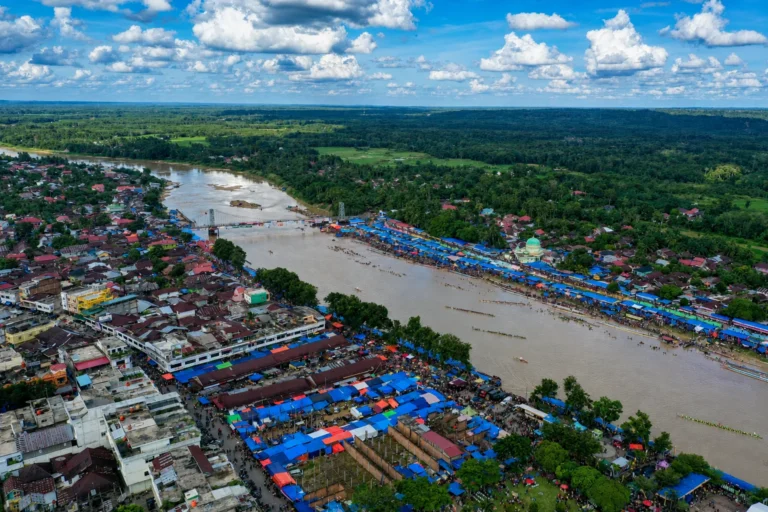
At around two o’clock in the morning on 18 February 2020, members of the Sungai Manggis Sejahtera Forest Farmers Group arrived at Hutanriau’s office in Pekanbaru.
They had travelled from Kuantan Singingi carrying an unusual harvest: approximately 600 kilograms of tampui, 100 kilograms of barangan, and 25 durian daun fruits.
“Please help us sell these forest products,” said Sunardi, the group’s leader.
The request sounded simple. Behind it, however, was a much larger challenge faced by forest communities across Riau. Their forests still produced valuable foods, but many of these products were unfamiliar to urban consumers and rarely reached established markets.
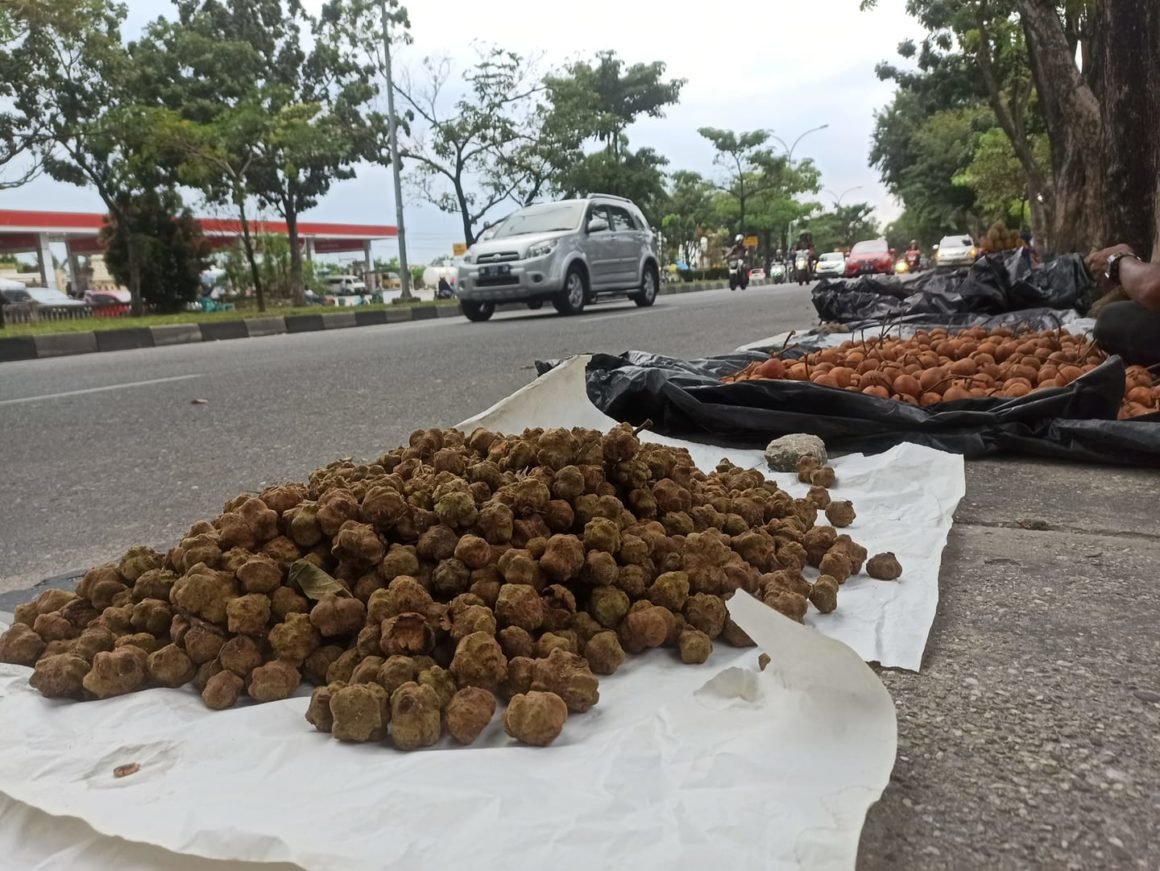
Later that morning, five members of the farmers group travelled with Hutanriau staff to Arifin Ahmad Street, one of Pekanbaru’s busy urban corridors. There, a simple roadside stall became a meeting point between forest farmers, city residents, and Riau’s increasingly overlooked food heritage.
Bringing forest foods into the city
Many people stopped because they had never seen the fruits before. Some were curious about their unfamiliar names, rough outer skins, and unusual shapes. Others recognised them from childhood.
One visitor remembered eating the fruit many years earlier but said it had become increasingly difficult to find. A woman from West Sumatra recognised tampui as kapunduang, the name used in her home region.
Younger visitors, however, were often seeing the fruit for the first time.
These encounters revealed how quickly knowledge can disappear. A fruit that is familiar to one generation can become unknown to the next when forests are converted, native trees are no longer cultivated, and local foods disappear from markets.
The roadside sale was therefore more than a commercial activity. It became an informal introduction to the biological and cultural diversity contained within Riau’s forests.
Tampui: different colours, one forest heritage
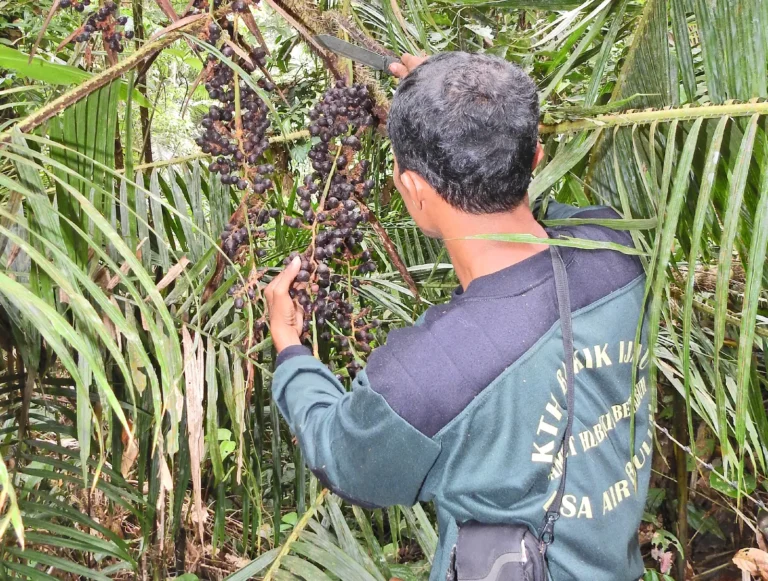
Tampui, scientifically known as Baccaurea macrocarpa, is a tropical forest fruit found in Sumatra, Borneo, the Malay Peninsula, and parts of mainland Southeast Asia.
The fruit has a thick outer skin and segmented flesh. Its flavour varies from mildly sour to sweet depending on its maturity.
Communities in Kuantan Singingi recognise at least two local varieties. Tampui Nasi has white flesh, while Tampui Kunyik has yellow or orange flesh resembling the colour of turmeric.
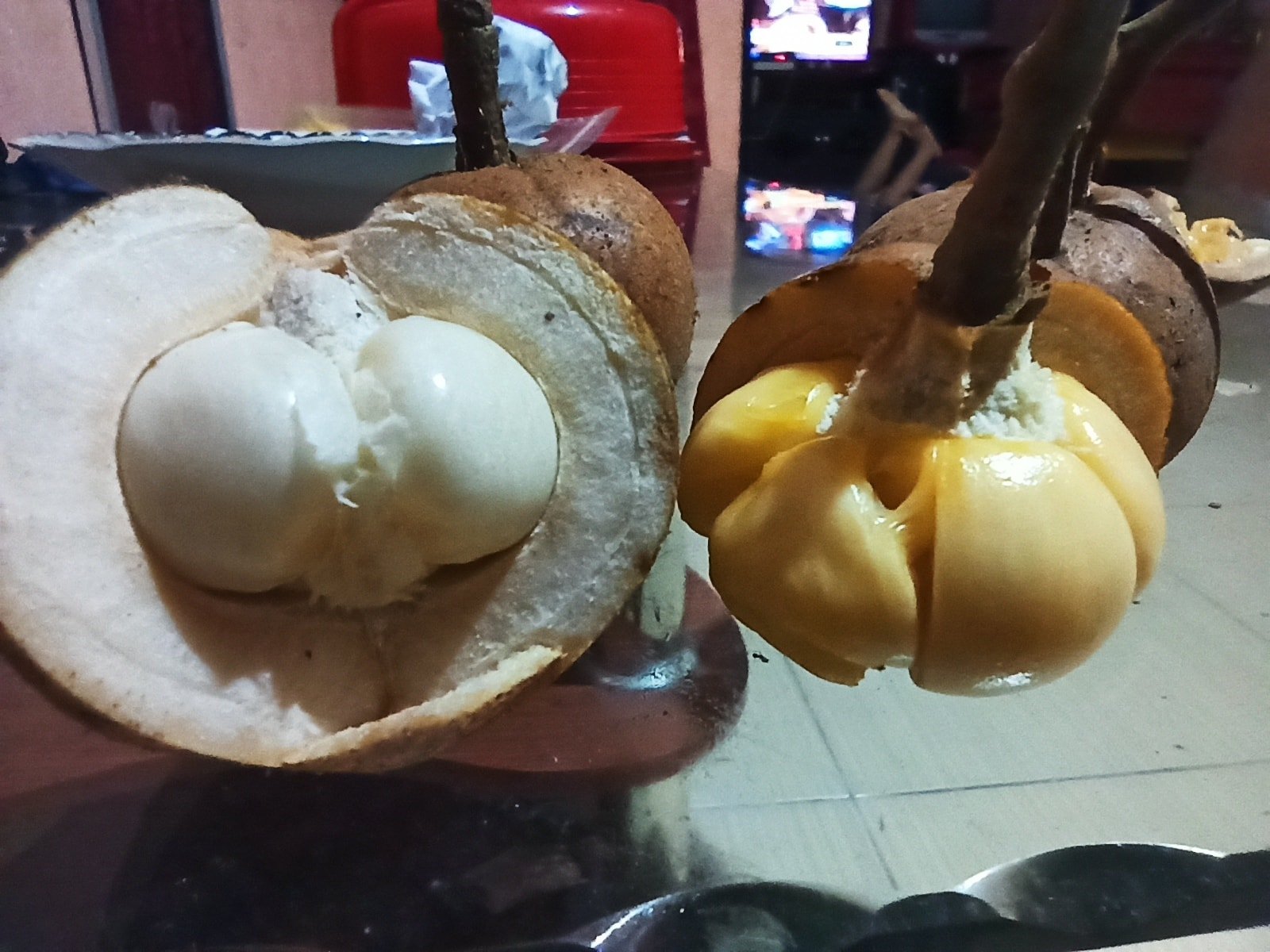
These local names reflect detailed knowledge developed through generations of observing, harvesting, and consuming forest fruits.
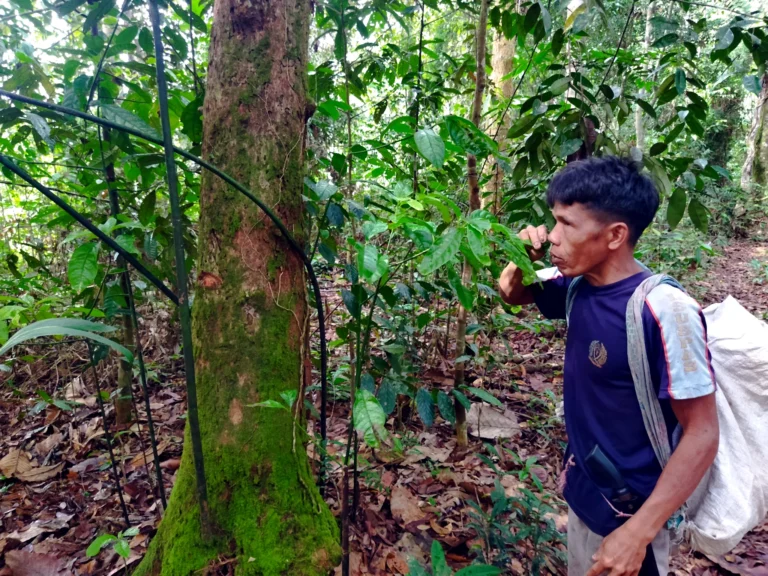
At the time of the farmers’ visit, most tampui was still collected from trees growing naturally in the forest.
“We are still harvesting it from the rimbo,” explained Rusli, a young farmer from Air Buluh village.
The word rimbo refers to the forest, but in local understanding it represents more than a collection of trees. It is a living landscape containing food, medicine, materials, wildlife, memories, and community knowledge.
Members of the farmers group had started experimenting with cultivating tampui. Their initiative was important because long-term conservation cannot depend entirely on harvesting from remaining natural trees.
Propagation, cultivation, and protection of parent trees are needed to ensure that future generations can continue to recognise and benefit from this native fruit.
Barangan: an overlooked forest food
Barangan is another native forest product known in different parts of Indonesia. The tree is locally associated with Castanopsis argentea, a member of the same botanical family as chestnuts.
In Java, the species is widely known as saninten. In Kuantan Singingi, communities recognise two local forms of barangan.
Barangan Ghunjo has a spiny outer covering, while Barangan Ghumpal has a rough but non-spiny surface. Despite their different appearance, community members describe the kernels as having a similar taste.
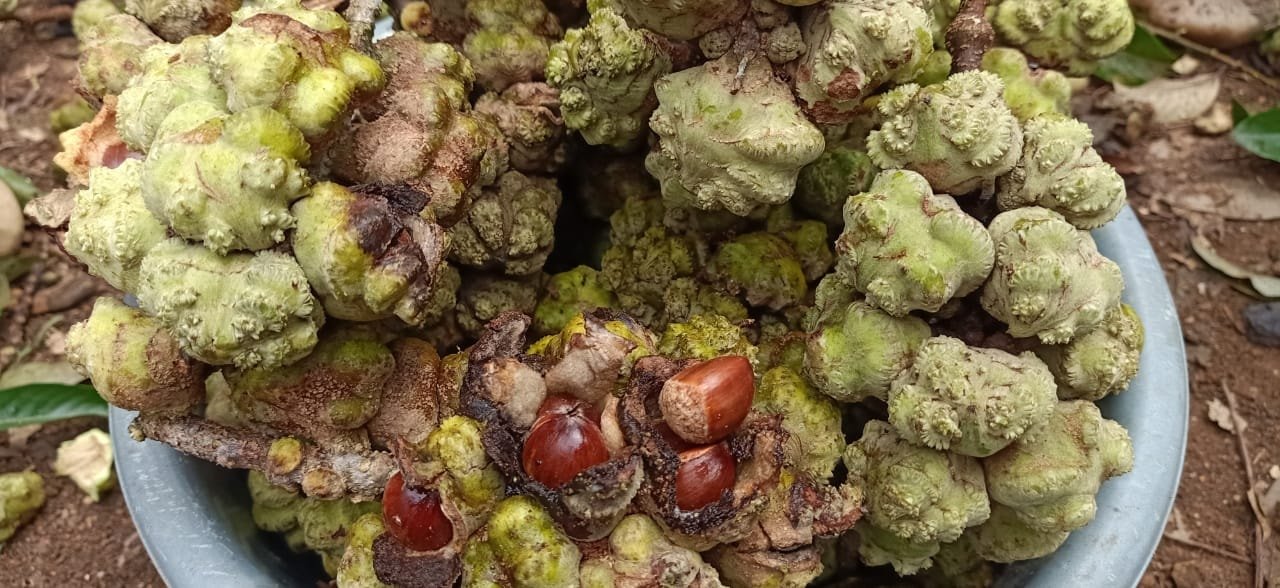
When roasted, barangan develops a distinctive aroma and a flavour somewhere between a nut and a starchy tuber.
“It tastes like a combination of a tuber and a nut. Roasting it releases a very distinctive fragrance,” explained Mat Gazali, a member of the forest farmers group.
Its potential may extend beyond direct consumption. With appropriate research, food-safety assessment, processing methods, and community-led market development, barangan could be processed into flour or other food products.
Any commercial development, however, must be based on sustainable harvesting, cultivation, community ownership, and fair benefit-sharing.
A forest food recognised nationally
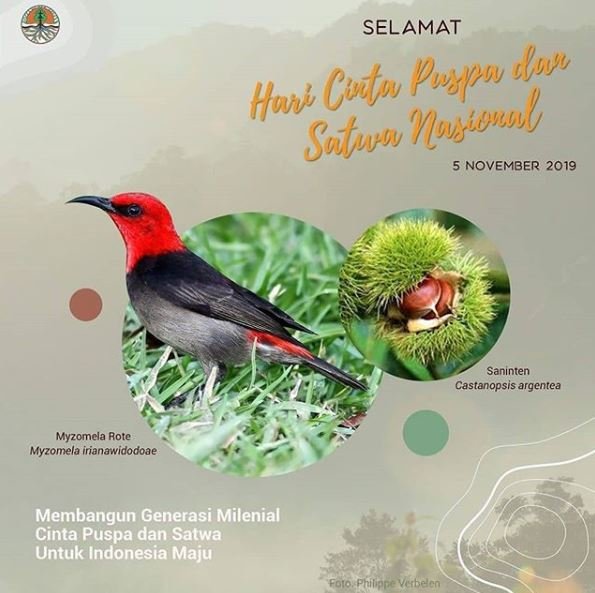
In 2019, saninten, the name commonly used for Castanopsis argentea in Java, was featured in Indonesia’s National Flora and Fauna Day campaign by the Ministry of Environment and Forestry.
Its appearance in the campaign highlighted the ecological importance of native plant species. For communities in Kuantan Singingi, however, barangan is not only a conservation symbol. It is also a food, a source of knowledge, and a potential community livelihood.
What disappears when a forest fruit is lost?
The decline of native forest fruits is not only a botanical concern.
When a species becomes difficult to find, communities may gradually lose knowledge about where the trees grow, when they flower and fruit, how they are harvested, which varieties are preferred, and how the seeds are selected and propagated.
Knowledge may also disappear about how the fruit is prepared, how it is shared, and how the tree relates to the wider forest ecosystem.
This knowledge is rarely contained in formal manuals. It is carried through practice, memory, language, family experience, and relationships between people and their landscapes.
The disappearance of a forest fruit can therefore mean the simultaneous loss of biodiversity, food diversity, cultural memory, and livelihood opportunity.
Conservation must create value for communities
Community-based conservation is more likely to endure when local people receive fair and meaningful benefits from maintaining forest resources.
Tampui and barangan illustrate the potential of non-timber forest products. Unlike economic activities that depend on clearing forests, these products can generate value while allowing trees and ecological functions to remain.
Market development must nevertheless be approached carefully. Sudden commercial demand can create pressure for excessive harvesting, particularly when the products still come primarily from natural forests.
A responsible approach requires community-led cultivation, sustainable harvesting rules, protection of parent trees, improved post-harvest handling, appropriate processing, fair market access, and recognition of local knowledge.
Hutanriau works to connect these elements. The objective is not simply to introduce unusual products to urban consumers. It is to strengthen a model in which forests remain standing because communities have the rights, knowledge, capacity, and incentives to manage them sustainably.
A roadside stall with a larger message
What began as an early-morning request for help became a small but meaningful public encounter.
On the roadside in Pekanbaru, city residents tasted fruits they had never seen. Older visitors remembered foods from their childhood. Farmers shared knowledge from their forests. Native species briefly became visible within an urban food market dominated by more familiar commodities.
The experience demonstrated that conservation does not always begin with a major campaign.
Sometimes, it begins with a farmer bringing a harvest from the forest, a passer-by stopping to ask a question, or a young person tasting an unfamiliar fruit for the first time.
Keeping tampui and barangan alive will require more than remembering their names. It will require protecting their habitats, cultivating their trees, documenting community knowledge, developing responsible markets, and ensuring that the people who maintain these resources receive a fair share of their value.
By protecting native forest foods, we preserve more than individual species. We sustain the relationships between forests, culture, food, knowledge, and community livelihoods.
Community-led conservation
Healthy forests must also support the people who protect them
Hutanriau works with forest communities to protect biodiversity, strengthen local knowledge, and develop sustainable livelihoods rooted in healthy landscapes.
This story is adapted from a Hutanriau field account documenting the visit of forest farmers from Kuantan Singingi to Pekanbaru on 18 February 2020.